A select few of you will want to stay in touch with me.
You will find that this blog is no longer a good way to do that.
Send me an email at sntjohnny @ sntjohnny . com in order to arrange for that.
–sntj
graphene domain was triggered too early. This is usually an indicator for some code in the plugin or theme running too early. Translations should be loaded at the init action or later. Please see Debugging in WordPress for more information. (This message was added in version 6.7.0.) in /home/sntjohn/public_html/front/wp-includes/functions.php on line 6170
A select few of you will want to stay in touch with me.
You will find that this blog is no longer a good way to do that.
Send me an email at sntjohnny @ sntjohnny . com in order to arrange for that.
–sntj
Anthony Horvath, PhD, is a Christian author, publisher, and apologist who works out of central Wisconsin. Contact him at director @ athanatosministries.org.
The word for the kind of work I do is ‘apologetics.’ It is from the Greek. Many joke: “Does this mean you are in the business of saying you are sorry?” Very funny! It actually means, “to make a defense.” Christian apologetics is the ‘defense of the Christian faith.’
This defense usually happens along intellectual grounds, and for some Christians that is an insult to the very idea of ‘faith.’ Obviously, it matters how we are defining our words, but suffice it to say, it is indeed possible to dwell too much on facts and arguments, but it still remains that the same God that brings us closer to him through faith in Christ also made our brains. Moreover, Jesus himself never relied on mere assertions and platitudes. He backed up his claims by miracles and appeals to the Scriptures. See, for example, John 14:11.
So, what kind of work is ‘apologetics,’ anyway? Well, one of the things I spend a lot of time doing is simply correcting misconceptions about the Bible, God, Jesus, and Christianity, and all the rest. Many times, I am talking with a non-Christian. Often, however, it is another Christian. When it is a Christian, they are often surprised to learn that a small detail can matter so much. However, when you spend as much time talking with people who have fallen away from the faith as Christian apologists tend to do, you learn that it was the small details that added up to fuel a crisis of faith in the first place.
This Easter, I want to call attention to one of those small details.
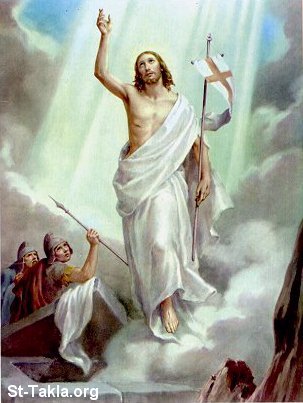
On this blog, one of the most popular articles I have posted is about the number of guards at the tomb of Jesus. Presumably, churches are putting on passion plays, and are looking for insight about that part of the play. (You may have noticed elsewhere in this magazine that my own ministry is doing a passion play this summer, called “The Passion Experience.”) Now, if you ask a group of Christians how many guards were at Jesus’ tomb, the general response will be that there were two guards.
Where does this idea come from?
It almost certainly tracks back to Christian art over the centuries, which almost always depicts the tomb with only two guards. This is a ‘fact’ that Christians believe about the resurrection account that is not derived from the Scriptures, but from artistic portrayals. Even the recent movie, “Risen” only has two guards at the tomb. I don’t mention this to condemn artistic portrayals. I am just explaining where this particular view probably arises, although it does naturally speak to the power of art more generally, which is something else my ministry spends a lot of time talking about.
Why does it matter?
Who cares how many guards were at the tomb?
Who cares if they were Roman guards, or temple guards, or both?
Imagine that you were evaluating whether or not it was a true fact of history that Jesus rose from the dead. If ever as a Christian there was a fact of the faith that one is counting on to be actually true and real, whether or not Jesus was truly resurrected is it! But many people challenge the historicity of the resurrection on the grounds that there are many other possible explanations for the disappearance of Jesus’ body, and the notion that the guards fell asleep and the body was, pardon the expression, spirited off somehow, is an obvious one to consider.
If there are only two guards, it is easy enough to imagine that they could have fallen asleep and someone snuck by them. But what if there were sixteen guards? What if there was even more than that? What if the penalty for falling asleep while on guard was death? For Roman guards, that is exactly the consequence for falling asleep. Things aren’t that much better for the Jewish guards. For example, in Acts 12, Herod orders the execution of the guards that were put in charge of watching Peter. If that is the penalty for losing a live person, imagine the penalty for losing a dead body!
Acts 12 also gives us an explicit reference to the number of guards, telling us it was sixteen.
Jesus’ death occurred during the Passover, when Jerusalem swelled from a population of a hundred thousand or so to more than a million (according to Josephus), and many of these were sympathetic to Jesus, and nearly all of them were hostile to the Romans. It was for this reason that Pilate was in Jerusalem in the first place. Given this hostility and the great crowds that were present, it is really inconceivable that fewer than sixteen guards would be tasked with watching the tomb, and it is equally incredible that all sixteen would have fallen asleep.
This little fact would have been well known to the Jews in Jerusalem, which is probably why when Jesus’ enemies concocted the story that the guards had fallen asleep… no one believed them.
No one believed them then, and no one should believe it now.
Do not underestimate the power of such little facts to accumulate and strengthen the faith of young Christians when they are taught such things. Similarly, do not underestimate the weight placed on a young person’s faith when a series of little facts seems to add up to the idea that Christianity is a fraud. Today more than ever, the little facts matter.
I have a post, simply titled “How many guards at Jesus’ tomb?” that has proved to be one of the most popular ones on this blog, drawing ten thousand visitors or so each year. The bulk of these come during the Easter season. I suspect that there are a lot of churches putting on Passion plays and they’re looking for some guidance on this topic (eg, how many costumes should they make for the guards, and should they be Roman costumes, or Jewish temple guard costumes?)
This year, to enhance the service that this post has evidently provided, I have written a number of other essays that are meant to corroborate various claims made within the post. Hopefully, these essays come soon enough for people to find useful for the Easter 2013 season.
The original post, and the complementary essays, can be read on this site (links below) but have also been compiled into an ebook (cover to the right). I have a couple of other claims that I’d like to eventually corroborate, so this collection of essays could grow.
Kindle | Nook | Smashwords
Original, Main Essay: “How many guards at Jesus’ tomb?”
Supplemental:
CONTINUED/ADDENDUM
The following material supplements the original essay on the guards at Jesus’ tomb and provides more corroboration for various statements that were made within it. It can be purchased as an ebook, cover to the right. (Next section: The Discipline of the Roman Soldier )
Were they Roman Guards or Temple Guards?
In some regards, it doesn’t matter whether the guards were Roman or Temple guards. The mere fact that there were guards represents a real problem for those who wish to dismiss the resurrection. If the tomb had been left unattended throughout the entire time between Jesus’ death and his alleged resurrection, we could posit countless other explanations for the absence of Jesus’ body. (His appearances in a glorified form would still require some explanation, but it is doubtful even that would be taken seriously if there was any question about the disposition of the body of Jesus.) The fact that there were people hostile to Jesus’ followers present and carefully monitoring the situation, however, significantly increases the weight of the resurrection claim–regardless of whether or not they were Jewish temple guards or Roman soldiers.
Clearly, though, the more trained these soldiers are, the less likely we can consider other scenarios, such as incompetence.
The text is ambiguous in some regards, as already alluded to in the main article. That said, there are several lines of evidence that suggest that there were, in fact, both Roman guards and temple guards. If this can be established, then the presence of Roman guards at the tomb does more than increase the likelihood that the resurrection account is the correct one, it virtually proves it. This is because the Roman guards, besides being exceptionally well trained and demonstrably well disciplined, they are motivated by a huge disincentive: the penalty for incompetence was often death, and all the more when the infractions occur on the ‘night watch.’ One can imagine how little leniency they could expect for managing to lose track of a dead body!
A plain reading of the text suggests that, at the minimum, the guards on station were Roman. Here are some reasons why:
1. In Matthew 28:11-15, the priests and elders pay the guards money to spin a particular story, and in exchange promise that “if this comes to the governor’s ears, we will satisfy him and keep you out of trouble.” It is hard to imagine why the Jewish leaders’ own guards needed to be concerned about what the governor thought. And they had every reason to be concerned, given the particular story they were being paid to tell: falling asleep during a watch was punishable by death, as will be demonstrated shortly. That they guards were concerned about word getting back to the governor shows that they in fact answered to the governor.
2. In Matthew 27:66, we have the Jews hurrying to the tomb and setting a seal. A seal would not have been anything more sophisticated than a bit of string or wax that would allow them to know if the stone had been disturbed. The disturbing of a seal given with the governor’s authority carried the penalty of death. Can we believe that Pilate would have given this authority to the Jews? Surely the seal would have been set by Pilate’s own representatives.
The Book of Matthew is a prime source for those inclined to view it as divine Scriptures, but it can be taken simply as a historical source, too. If we are open to other documents of historical value, we find that some other ancient sources address this issue, providing interesting corroboration.
3. The so-called ‘Gospel of Peter‘ was rejected by the Christian Church as apocryphal, which in some minds actually enhances its credibility. Nonetheless, it gives early testimony to what was actually believed in the first centuries after Christianity began to spread. From the ‘Gospel of Peter’ (70-160 AD) we hear explicitly that it was Roman guards that were dispatched; we even learn his name: Petronius.
2 And the elders were afraid and came unto Pilate, begging him and saying, 3 “Give us soldiers that we may guard his tomb for three days, lest his disciples come and steal him away and the people suppose that he is risen from the dead, and do us harm.” 4And Pilate gave them Petronius the centurion with soldiers to watch the tomb. And the elders and scribes came with them unto the tomb. 5 All who were there with the soldiers rolled a great stone to the entrance of the tomb 6 and plastered seven seals on it. Then they pitched a tent there and kept watch.
9 Early in the morning, as the Sabbath dawned, there came a large crowd from Jerusalem and the surrounding areas to see the sealed tomb. 2 But during the night before the Lord’s day dawned, as the soldiers were keeping guard two by two in every watch, there came a great sound in the sky, 3 and they saw the heavens opened and two men descend shining with a great light, and they drew near to the tomb. 4 The stone which had been set on the door rolled away by itself and moved to one side, and the tomb was opened and both of the young men went in.
10 Now when these soldiers saw that, they woke up the centurion and the elders (for they also were there keeping watch).
4. Another early, non-canonical work, the so-called “Report of Pilate to the Emperor Claudius” says, “…and they crucified him, and when he was buried they set guards upon him. But while my soldiers watched him he rose again on the third day: yet so much was the malice of the Jews kindled that they gave money to the soldiers, saying: Say ye that his disciples stole away his body. But they, though they took the money, were not able to keep silence concerning that which had come to pass, for they also have testified that they saw him arisen and that they received money from the Jews.”
5. The Gospel of Nicodemus contains within it a section called the “Acts of Pilate” (and even is sometimes referred to as that; c. 200-350 AD) and has a statement that says, “And while they were still sitting in the synagogue, and wondering about Joseph, there come some of the guard whom the Jews had begged of Pilate to guard the tomb of Jesus, that His disciples might not come and steal Him.”
Later in the same, “And they crucified him, and set guards over him when buried. And he rose again on the third day, while my soldiers were keeping guard. But so flagrant was the iniquity of the Jews, that they gave money to my soldiers, saying, Say that his disciples have stolen his body. But after receiving the money they could not keep secret what had been done; for they bore witness both that he had risen again, that they had seen him, and that they had received money from the Jews.”
Both Roman guards and Jewish guards are clearly and explicitly in view.
6. Matthew uses several words to refer to the guards: custodios, stratiotas, and tarountes (‘the watch.’) ‘Straiotas’ translates simply as ‘soldiers.’ It appears in this context in Matthew 28:12 where we read that the chief priests and elders gave a large sum of money to the ‘stratiotas’, or soldiers. It is this very same word that Matthew uses in Matthew 27:27, where we read that “the soldiers of the governor took Jesus into the Praetorium” (in order to beat him to a pulp). While we are told that Herod had soldiers, (Luke 23:11 and Acts 12:4-18) the chief priests, elders and Pharisees are never described as having ‘soldiers.’ They, instead, have ‘officers,’ a point we will return to later. The other three Gospels each use this word, ‘straiotas,’ in reference to soldiers serving under the direct command of Pilate: Mark 15:16, Luke 23:36, and John 19:2, 23-34. The simplest inference is that when Matthew uses the word, he is thinking of it in exactly the same terms as we see it used in the other three Gospels, and indeed, how he used it himself in his own account: 8:9 and 27:27.
The clear implication is that Matthew is referring to Roman guards dispatched by Pilate, and the extra-biblical books make what is implicit in Matthew explicit in their accounts.
The same texts imply, or explicitly state, that Jewish guards were present as well. The Gospel of Peter is explicit, while the Report of Pilate is implicit. In Matthew, after Jesus’ body disappears, they do not report to their own superiors, but to the chief priests. This implies some kind of working relationship between the guards and the Jews that prompts them to reasonably hope that their fates will be better if they turn to the Jews, rather than their own; inferring the existence of Jewish guards bridges this nicely.
Here, then, are four different sources attesting to the presence of Roman guards at the tomb, and moreover many others besides (16 or more guards, the elders, etc). As there was no love lost between the Jews and early Christians, if Jewish temple guards were the one referred to in Matthew, the early Christians would have no qualms in mentioning this fact in their later writings. The early consensus is that Pilate dispatched his own guards, and the Jews had their own people present, too.
Having both Jewish and Roman guards on scene provides us with yet another layer of credibility to the account, because the two groups were not exactly on great terms. After all, the Romans are present as occupiers, and the Jews are deeply resentful of that fact. Fortunately, the value we get from looking at the nature of the training of the guards resides almost wholly on the folks more conclusively documented to be present, the Romans. So that, even if we don’t accept that the Jews are also guarding the tomb, we still have many reasons to believe the Romans would have done a fine job–which is precisely why the resurrection account is so historically robust.
However, we will probe the relationship between the Romans and the Jews a little more deeply to better understand why it is unlikely the Jews would have left the matter to the Romans to handle alone.
But first, let’s talk about Roman training and discipline.
(this is the continuation of a series of essays discussing the number and make-up of the guards at Jesus’ tomb. It can be purchased as an ebook, cover to the right. Main essay | Previous section | Next section: The Romans and Jews: So (un)Happy Together )
The Discipline of the Roman Soldier
Most acknowledge that the Roman military was very good at what it did without really looking at the details. The concession is made easily enough because most of us learned in history class that the Romans conquered a great deal of territory, and we infer, without really thinking about it much, that in order to do this, they must have been reasonably competent. The details are important, though. Sometimes, one gets the idea that people think the Romans only had to deal with barbaric, unorganized thugs, here and there–as if they never defeated other standing armies of significant ability. But this, they did. In other words, they were highly skilled warriors with a great deal of experience, and when one begins to delve into just how skilled they were, and how deep their experience it was, the fact that they were on duty over Jesus’ dead body heightens the question as to how it could have possibly gone missing.
Roman historians themselves have provided us with ample descriptions of their armies at work. We will touch on a handful of examples that are particularly relevant to guard duty, but it is worth pointing out that death was a very common solution to any number of perceived deficiencies, and this includes infractions such as falling asleep on guard duty.
A 1928 academic work by Dr. George W. Currie titled The Military Discipline of the Romans from the Founding of the City to the Close of the Republic systematically lists all examples of infractions recorded in a wide variety of sources, groups them by periods, and describes what the consequences were. One of his basic conclusions is that the Romans were extremely severe upon their own soldiers throughout their rule.
Salient examples include an instance in 390 BC when some Roman guards were asleep on duty and the Citadel of Rome was attacked; the particular guard at fault was subsequently thrown from a cliff. In 322/295 BC, two legions yielded their post. Men were selected from the offenders by lot, and put to death. In 280/271, guards were scourged and beheaded, and their bodies dishonored. In 205 BC, guards allowed items to be stolen from a temple. They had to pay back the value of the items two-fold, or else be put to death. A similar consequence was put upon the guards that allowed two ships to be captured. In 39 BC, two centuries (presumably about 200 men) failed to prevent a lieutenant and his men from being ambushed. The consequence was decimation: every tenth man was counted off, and the selected men were put to death.
In 4 out of the 6 examples that Currie documented, death was inflicted upon the deficient guards. In the other 2, death was right around the corner.
One can begin to see why a Roman guard (and soldier in general) would want to do his very best. If he was lucky, his incompetence would merely result in his dishonorable discharge. More likely, he would die.
It was already mentioned in the main article that Herod put to death all 16 of the guards in charge of keeping Peter in prison (Acts 12:4). It was apparently a common practice that remained well known and in place up to and through the time of Jesus.
The Roman historian Polybius gives us one of the most thorough accounts of the Roman’s military discipline, and we are benefited by the fact that he takes time to specifically detail the duties of the ‘night watch,’ and, importantly, consequences of failure. Here is the relevant portion:
The way in which they secure the passing round of the watchword for the night is as follows: from the tenth maniple of each class of infantry and cavalry, the maniple which is encamped at the lower end of the street, a man is chosen who is relieved from guard duty, and he attends every day at sunset at the tent of the tribune, and receiving from him the watchword — that is a wooden tablet with the word inscribed on it — takes his leave, and on returning to his quarters passes on the watchword and tablet before witnesses to the commander of the next maniple, who in turn passes it to the one next him. All do the same until it reaches the first maniples, those encamped near the tents of the tribunes. These latter are obliged to deliver the tablet to the tribunes before dark. So that if all those issued are returned, the tribune knows that the watchword has been given to all the maniples, and has passed through all on its way back to him. If any one of them is missing, he makes inquiry at once, as he knows by the marks from what quarter p349the tablet has not returned, and whoever is responsible for the stoppage meets with the punishment he merits.
They manage the night guards thus: The maniple on duty there guards the consul and his tent, while the tents of the tribunes and the troops of horse are guarded by the men appointed from each maniple in the manner I explained above. Each separate body likewise appoints a guard of its own men for itself. The remaining guards are appointed by the Consul; and there are generally three pickets at the quaestorium and two at the tents of each of the legates and members of the council. The whole outer face of the camp is guard by the velites, who are posted every day along the vallum — this being the special duty assigned to them — and ten of them are on guard at each entrance. Of those appointed to picket duty, the man in each maniple who is to take the first watch is brought to the tribune in the evening by one of the optiones of his company. The tribune gives them all little tablets, one for each station, quite small, with a sign written on them and on receiving this they leave for the posts assigned to them.
The duty of going the rounds is entrusted to the cavalry. The first praefect of cavalry in each legion must give orders early in the morning to one of his optiones to send notice before breakfast to four lads of his own squadron who will be required to go the rounds. The same man must also give notice in the evening to the praefect of the next squadron that he must make arrangements for going the rounds on the following day. This praefect, on receiving the notice, must take precisely the same steps on the next day; and so on through all the squadrons. The four men chosen by the optiones from the first squadron, after drawing lots for their respective watches, go to the tribune and get written orders from him stating what stations they are to visit and at what time. After that all four of them go and station themselves next the first maniple of the triarii, for it is the duty of the centurion of this maniple to have a bugle sounded at the beginning of each watch. When this time comes, the man to whom the first watch fell by lot makes his rounds accompanied by some friends as witnesses. He visits the posts mentioned in his orders, not only those near the vallum and the gates, but the pickets also of the infantry maniples and cavalry squadrons. If he finds the guards of the first watch awake he receives their tessera, but if he finds that anyone is asleep or has left his post, he calls those with him to witness the fact, and proceeds on his rounds. Those who go the rounds in the succeeding watches act in a similar manner. As I said, the charge of sounding a bugle at the beginning of each watch, so that those going the rounds may visit the different stations at the right time, falls on the centurions of the first maniple of the triarii in each legion, who take it by turns for a day.
Each of the men who have gone the rounds brings back the tesserae at daybreak to the tribune. If they deliver them all they are suffered to depart without question; but if one of them delivers fewer than the number of stations visited, they find out from examining the signs on the tesserae which station is missing, and on ascertaining this the tribune calls the centurion of the maniple and he brings before him the men who were on picket duty, and they are confronted with the patrol. If the fault is that of the picket, the patrol makes matters clear at once by calling the men who had accompanied him, for he is bound to do this; but if nothing of the kind has happened, the fault rests on him. A court-martial composed of all the tribunes at once meets to try him, and if he is found guilty he is punished by the bastinado ( fustuarium). This is inflicted as follows: The tribune takes a cudgel and just touches the condemned man with it, after which all in the camp beat or stone him, in most cases dispatching him in the camp itself. But even those who manage to escape are not saved thereby: impossible! for they are not allowed to return to their homes, and none of the family would dare to receive such a man in his house. So that those who have of course fallen into this misfortune are utterly ruined. The same punishment is inflicted on the optio and on the praefect of the squadron, if they do not give the proper orders at the right time to the patrols and the praefect of the next squadron. Thus, owing to the extreme severity and inevitableness of the penalty, the night watches of the Roman army are most scrupulously kept.
[SOURCE]
We will re-iterate what Polybius himself concluded as self-evident: “Thus, owing to the extreme severity and inevitableness of the penalty, the night watches of the Roman army are most scrupulously kept.”
What applies to small groups, and guards on the night watch, is applied to large groups that ‘desert their posts’ in the form of ‘decimation.’
If the same thing ever happens to large bodies, and if entire maniples desert their posts when exceedingly hard pressed, the officers refrain from inflicting the bastinado or the death penalty on all, but find a solution of the difficulty which is both salutary and terror-striking. The tribune assembles the legion, and brings up those guilty of leaving the ranks, reproaches them sharply, and finally chooses by lots sometimes five, sometimes eight, sometimes twenty of the offenders, so adjusting the number thus chosen that they form as near as possible the tenth part of those guilty of cowardice. Those on whom the lot falls are bastinadoed mercilessly in the manner above described; the rest receive rations of barley instead of wheat and are ordered to encamp outside the camp on an unprotected spot. As therefore the danger and dread of drawing the fatal lot affects all equally, as it is uncertain on whom it will fall; and as the public disgrace of receiving barley rations falls on all alike, this practice is that best calculated both the inspire fear and to correct the mischief.
When one now considers how detailed and thorough the Romans attended to the specific task of guarding themselves, and how severe the consequences were, we must conclude that it is highly implausible that the Roman guards could have fallen asleep at Jesus’ tomb. We can also understand why, after it was clear that the body was gone, that they decidedly would not want to report this fact to their superiors. Their only hope was that the Jews would protect them. The alternative, literally, was death. But would the Jews play ball?
The Jews were not inclined to be sympathetic to the Romans. The idea of dead Roman soldiers must have been, in the main, a very pleasant one to turn about in one’s mind. However, what if balanced against this highly desirable prospect was a very undesirable prospect, that Jesus’ followers would begin announcing to all that Jesus had risen from the dead?
Or, to put it differently: if the Jewish leaders were the Roman guards’ only hope, it could also be said that the Roman soldiers were the Jewish leaders’ only hope.
To understand this tension more fully, and to better appreciate the reasoning behind the assertion that the Jews would not have entrusted Jesus’ tomb only to the Romans, we must now take some time to examine the relationship of these two peoples.
(this is the continuation of a series of essays discussing the number and make-up of the guards at Jesus’ tomb. It can be purchased as an ebook, cover to the right. Main essay | Previous section | Next section: Pilate Puts Jesus on Trial, the Jews put Pilate on Trial )
The Romans and Jews: So (un)Happy Together
The region of Palestine had been conquered by one empire after another before the Romans finally took hold of it around 70 BC. Indeed, going back even as far as the book of Exodus, we find that one of the roads through the region was called “The Way of the Kings,” presumably because this was the road that the kings marched their armies to war on their way to conquer something more important. The Romans no doubt regretted taking possession of the area, as the occupants were irascible folks, constantly nipping at their heels, all of whom had the unfortunate belief that their own king’s arrival was imminent.
Unfortunately for the Romans, and the Greeks, and the Persians, and the Egyptians, and the [fill in the blank], Palestine had to be dealt with if one wished to conquer the world. If you look at a map, you will understand why. To the east of the region is a vast wilderness and desert. If Greece wanted to attack Egypt, they had to go through Palestine. If Egypt wanted to attack Persia, they had to go through Palestine. So on and so forth. You get the picture; it was the Way of the Kings for a reason: it was the only way for the kings.. Studying a map of the area would be a good idea at this point.
Detailing the troubled relations between the Romans and the Jews would take a book to accomplish, but focusing on Pontius Pilate’s rule over the Jews is a suitable snapshot, especially as it has bearing on Jesus’ death and resurrection, since Pilate, of course, was the man on the scene.
Pilate was the governor of Judea from 26 AD to 36 AD. In this ten years, he made few friends in the region.
The Jewish writer Philo in his “Embassy to Gaius” tells of many injustices done to the Jews by the Romans, but relates several specific stories about Pilate’s actions.
The first story involves Pilate having some shields with (innocent) inscriptions placed in Herod’s palace, in Jerusalem. This outraged the Jews, who were steadfastly opposed to such things. Pilate is described as a man of a very inflexible disposition, and very merciless as well as very obstinate.”
The Jews at last threaten to send a letter to Tiberius, and Pilate, fearing they might actually follow through on their threat, and so expose Pilate “with respect to other particulars of his government, in respect to his corruption, and his acts of insolence, and his rapine, and his habit of insulting people, and his cruelty, and his continual murders of people untried and uncondemned, and his never ending, and gratuitous, and most grievous inhumanity.”
This gives you a flavor of how Philo the Jew perceived Pilate. In the end, Pilate sent the letter himself rather than let the Jews send it; The Emperor’s response is reported to be less than happy with Pilate; Pilate removes the shields.
Josephus, the Jewish historian, tells of some other conflicts between Pilate and the Jews.
In one of them, Pilate again brings images into Jerusalem. The people are outraged and appeal to him. When Pilate refuses to have them removed, “they fell down prostrate upon the ground, and continued immovable in that posture for five days and as many nights.” What happens next is best told in full:
On the next day Pilate sat upon his tribunal, in the open market-place, and called to him the multitude, as desirous to give them an answer; and then gave a signal to the soldiers, that they should all by agreement at once encompass the Jews with their weapons; so the band of soldiers stood round about the Jews in three ranks. The Jews were under the utmost consternation at that unexpected sight. Pilate also said to them that they should be cut in pieces, unless they would admit of Caesar’s images, and gave intimation to the soldiers to draw their naked swords. Hereupon the Jews, as it were at one signal, fell down in vast numbers together, and exposed their necks bare, and cried out that they were sooner ready to be slain, than that their law should be transgressed. Hereupon Pilate was greatly surprised at their prodigious superstition, and gave order that the ensigns should be presently carried out of Jerusalem.
At this point, one might feel like they could describe the relationship between Pilate and the Jews as an immovable wall meeting an unstoppable force, except for the fact that Pilate does, in the end, relent.
Josephus proceeds immediately then to tell the story of Pilate raiding the temple treasury to pay for aqueducts. This time when the Jews showed up to protest,
“he mixed his own soldiers in their armor with the multitude, and ordered them to conceal themselves under the habits of private men, and not indeed to use their swords, but with their staves to beat those that made the clamor. He then gave the signal from his tribunal [to do as he had bidden them]. Now the Jews were so sadly beaten, that many of them perished by the stripes they received, and many of them perished as trodden to death by themselves; by which means the multitude was astonished at the calamity of those that were slain, and held their peace.”
So, that time, the immovable wall held fast. Eventually, Pilate’s violent and aggressive tactics would lead to his dismissal. Josephus recounts that Pilate slaughtered some Samaritans (a group of people living in Palestine), who then complained to the governor of Syria, who in turn sent Pilate to Rome. Little is known about Pilate’s fate after this, but it is against this brutal pattern of behavior and disregard and contempt for the Jews that we must now consider the story of Jesus’ trial and the guarding of the tomb.
(this is the continuation of a series of essays discussing the number and make-up of the guards at Jesus’ tomb. It can be purchased as an ebook, cover to the right. Main essay | Previous section | Next section: The Presence of Jewish Guards at the Tomb )
Pilate puts Jesus on Trial, the Jews put Pilate on Trial
In light of the foregoing, many skeptics have pointed to the nearly docile Pontius Pilate of the Gospel accounts as proof positive that they cannot possibly reflect real history. The character and demeanor of the Pilate that Jesus met is nothing like the character and demeanor of the Pilate of Philo and Josephus. The possibility that Pilate’s radical transformation–for a brief few days–is a testament to the over-awing impression that meeting Jesus–the creator of both the immovable wall and the unstoppable force–has on someone doesn’t cross their minds.
Which version you prefer seems to depend on what degree you’re willing to take the documents on their face–all of them, Philo, Josephus, and the Gospels–or rather assume that the Gospels are guilty until proven innocent (which they cannot believe can even conceivably be done). Nonetheless, there may be some threads in the Gospel narratives that might take on new significance given the brief history we’ve sketched of Pontius Pilate using extra-biblical sources… and in doing so, add credibility to the Gospel accounts. Perhaps it is the same man being described, after all.
At any rate, with this background in mind, can you see now why it would have been extraordinarily unlikely that the Jews would not have wanted to have some of their own men present at the tomb? On the one hand, they might be saying, “If this man is reported risen from the dead, this will be worse than it already is!” but on the other hand they would be saying, “I wouldn’t put it past Pilate to try something to make our lives miserable!”
In the Gospel accounts, this tension between the two parties is clear, even in the sections where Pilate is putting Jesus on trial.
Indeed, in the Gospel of Luke, where Pilate will later come off as timid as in the other Gospels, we read the account of Pilate having the blood of Galileans mixed with their own sacrifices, and the question put to Jesus whether or not they had sinned enough to deserve such treatment (Luke 13:1). Pilate is a horrible, bloodthirsty guy, who is stubborn to boot. But it is the Jews and their leadership he detests the most. He would love to let Jesus go free, even if only to spite the men he hates. Actually meeting Jesus, though, seems to compel him to look beyond his own petulance.
In Matthew 27:18, the text indicates that Pilate knew exactly what the Jewish leader’s real motive was: envy. Pilate tries to evade the issue by sending Jesus to Herod, but this does not work. Then Pilate attempts a ploy whereby Barabbas is set against Jesus by comparison; presumably, Pilate expects the Jews to be very familiar with Barabbas. Perhaps Barabbas is in prison to begin with because the Jews had requested it. Pilate fails in this ploy, too. Finally, Pilate has Jesus flogged, hoping that with blood now being shed, the Jews will relent (John 19:1-5).
Pilate is a stubborn man who, as we’ve already seen, is perfectly willing to play things out to the end in order to get what he wants. But the immovable wall is about to meet the unstoppable force one more time.
Having fully established in his own mind that he was going to do everything in his power to have Jesus released, the Jews now spring their trap:
“If you release this man, you are not Caesar’s friend. Everyone who makes himself a king opposes Caesar.” (John 19:12)
We will now recall how the Jews have already previously threatened to tattle on Pilate, and Philo’s account of how Pilate’s attempt to circumvent this by sending his own letter to his superiors ended up with him in hot water, and having to remove the shields from Jerusalem. The Samaritans actually will succeed in having Pilate removed by sending complaints to Pilate’s superior. This is no idle threat the Jews are making, and the possible consequences to him (ie, exile or death) are not imagined. Pilate knows all this. Pilate recognizes precisely what the Jews mean by their suggestion that he would not be “Caesar’s friend.”
But the really amazing statement comes from a series of subtexts set in motion by the intimation of ‘someone making themselves a king.’ Pilate is now perhaps at his wits end, but desires to tweak the Jews. He brings Jesus to the Stone Pavement for all to see, and declares, “Behold your King!” To this, the Jews scream that Jesus is to be crucified. Pilate says, “Shall I crucify your king?” To this, the Jews make this truly startling retort: “We have no king but Caesar!”
Skeptics have scoffed at the change of personality that Pilate seems to have undergone, but failed to observe the change of personality of the Jews. These are the same people who laid down for five days rather than tolerate images from entering their holy city. They are the same people who rioted with the presence of shields graced merely with writing on them. They are the same people who rioted when Pilate paid for an aqueduct out of the temple treasury, and paid for it with their lives. They are the same people with zealots running around assassinating various Roman officials. They are the same people swearing extreme devotion to the God of Abraham, Isaac, and Jacob. They are the same people fervently expecting their own king, who will throw off the yoke of all oppressors, and finally establish a kingdom that will not end.
It is these people who now say that they have no king but Caesar.
When Pilate hears this, he knows that his foes have completely left the reservation. They have totally sold out on all of their principles and beliefs, and they had already shown that they were ready to die for those principles and beliefs. If one was willing to die for the one set of principles, what might they do for the other principles, that apparently are superior to the former principles?
The unstoppable force wins again, because there truly is nothing that will stop them from their goal of having Jesus killed. Jesus could very well have been God and their rightful king, but the Jewish leaders in the final analysis cared little about that. It was their own power they wished to secure, and their own skins they wished to save.
The unstoppable force may have gained its primary objective, but the unmovable wall is not finished. He decrees that a sign be fixed to Jesus’ cross declaring Jesus to be the king of the Jews in three languages. The Jews don’t like to be needled: they ask for the inscription to be re-written for ‘accuracy.’ Pilate is pleased they are annoyed. He retorts: “What I have written I have written.” It’s a small victory, but Pilate is the sort of man who will take any victory rather than no victories.
When Jesus dies and Joseph of Arimathea comes to ask for Jesus’ body, Pilate is pleased to grant his request. When the Jews heard about it, they could not have been very happy. Their ‘request’ is laced again with the subtext of contempt that Pilate and the Jews shared for each other: “lest his disciples go and steal him away and tell the people, ‘He has risen from the dead,’ and the last fraud will be worse than the first.” And the first fraud was of Jesus’ claim to be king–a proposition that already drove the Jews to threaten to take the matter to Caesar. The unstoppable force wins again; it would prove to be its last victory.
The Gospel accounts, far from showing themselves contradictory to history in regards to the real nature and character of Pilate and his relationship to the Jews, are actually extraordinarily consistent with those things. Pilate and the Jews are at each other’s throats throughout the exchanges, with each trying to get under the other’s skin. With this as the context, can we imagine the Jews would want to have the Roman guards at the tomb without having their own officers present? It seems unfathomable.
The Jews seem to end with the upper hand, but it backfires miserably. By ensuring that Roman guards are present at the tomb in sizable numbers, when the body of Jesus does actually go missing, their explanation that the disciples stole the body seems weak and pathetic. After all, if we can ascertain today how dangerous it was for a Roman guard to fall asleep at their post, how common and well known was it at that time, for people who actually lived under the Roman thumb?
This alone is enough to explain why the other account, that Jesus had actually rose from the dead, spread like wildfire, and the idea that the disciples stole the body became a mere footnote to the story.
However, the presence of Jewish guards at the scene would have also eliminated another possibility: that Pilate had been up to shenanigans.
(this is the continuation and the conclusion of a series of essays discussing the number and make-up of the guards at Jesus’ tomb. It can be purchased as an ebook, cover to the right. Main essay | Previous section: Pilate Puts Jesus on Trial, the Jews put Pilate on Trial)
The Presence of Jewish Guards at the Tomb
It has been maintained that both Jewish and Roman guards were present at the tomb. It was shown at length that Roman guards were present, and some evidence presented that describes how Romans went about such work. In my opinion, the arguments already presented encompassed sufficient reasons for believing that men under the service of the elders and chief priests were at the tomb.
To reprise:
1. The Gospel of Peter (70-160 AD) has both Roman soldiers and representatives of the elders and scribes at the tomb throughout the entire event–see verses 9.4 and 10.1. The passage continues to place the Jewish leaders at the scene, having them actually with the centurion, and they themselves personally going to Pilate to ‘smooth things over.’
2. The so-called “Report of Pilate to the Emperor Claudius” explicitly puts both parties together: “…and they crucified him, and when he was buried they set guards upon him. But while my soldiers watched him he rose again on the third day.”
3. The Gospel of Nicodemus/Acts of Pilate (c. 200-350 AD) says, “And while they were still sitting in the synagogue, and wondering about Joseph, there come some of the guard whom the Jews had begged of Pilate to guard the tomb of Jesus, that His disciples might not come and steal Him” and later in the same, “And [the Jews] crucified him, and set guards over him when buried. And he rose again on the third day, while my soldiers were keeping guard.”
All three of these documents explicitly put both Roman and Jewish guards at the scene, and implicitly have them all involved in the affair throughout. I have already argued in the main article that this is implicit in the Gospels, too.
However, it might be said after all this that the Jews did not actually have their own armed men. This can be refuted pretty easily as a general contention, but to keep it in the context of the event under discussion, we will point out that while it may be true they didn’t have their own soldiers, the elders did have their own armed officers, and they did make appearances in Jesus ‘final days.’
When Judas moved to betray Jesus, he led a cohort (‘speira’, so possibly a band of Roman soldiers) and “officers from the chief priests and the Pharisees”, equipped with lanterns, torches and weapons (John 18:3).
The word for ‘officers’ is ‘huparetas’, which according to Thayer’s lexicon, means:
servant an underrower, subordinate rower any one who serves with hands: a servant in the NT of the officers and attendants of magistrates as — of the officer who executes penalties of the attendants of a king, servants, retinue, the soldiers of a king, of the attendant of a synagogue of any one ministering or rendering service any one who aids another in any work an assistant of the preacher of the gospel
Jesus confronts the chief priests and officers, plainly putting weapons in their hands, in Luke 22:52: “Then Jesus said to the priests and officers of the temple and elders who had come against him, ‘Have you come out with swords and clubs as you would against a robber?” See also John 7:32-45 and 18:22
These officers are even present before Pilate, and seem to be among those calling for Jesus’ crucifixion: “So when the chief priests and the officers saw him, they cried out saying, ‘Crucify him! Crucify him!'”
So we see that there is a ready pool of armed men from which the chief priests could draw from right up to the very hours before Jesus’ burial. For reasons already explained, and upon evidence already presented, it is very safe to believe that both Jewish and Roman guards were present at the tomb. This being the case, when Jesus’ body goes missing, despite all these people watching it, one can understand why the argument that the disciples stole the body was seen immediately as ridiculous on its face, and why, when added to everything else, the other view was immediately accepted: Jesus had truly risen from the dead.
It is that time of year again, when skeptics begin leveling their claims that Christianity is just a re-packaged bit of borrowed paganism and [insert your conspiracy theory here]. For the sake of this post, let’s merely concede that there are similarities to ancient myths and train our minds on the critical distinction: none of them are set against a historical backdrop as fleshed out as Christianity. In other words, it may be absolutely true that Christianity is ‘borrowed’ but the fact that the resurrection actually happened, nonetheless, only means looking with less skeptical eyes on the ‘ancient myths.’ For example, we might ask ourselves if the ancient myths were foreshadows. A standard literary device. I’m sure most have heard of it: including God.
Depending on which mutually contradictory conspiracy theory we are working from, the basic contention is that perhaps something happened around 30 AD, but it was just a kernel which was inflamed into something more by later generations. For example, we see the same thing today with Gandhi. Ghandi died in 1948 and already people are running around saying that he was God, that he isn’t buried but ascended into heaven, etc. 60 years has passed, so it makes perfect sense that people could come to believe anything, see? Ah, you’re right. The Hindu religion has high disdain for introducing new gods and so are unlikely to engage in such a deification process… [This is sarcasm. No one claims that Gandhi claimed to be God, or that he rose from the dead, and the Hindu religion, in contrast to Judaism, welcomes new deities with welcome arms.]
One of the purposes of this post is to offer a hard cap on such conspiracy-mongering. I want to focus mainly on the Gospel of Matthew although some of this applies in other contexts as well.
Matthew’s Emphasis
The emphasis on showing how Jesus fulfilled various aspects of the Old Testament is clearly discernible. The constant refrain of “this happened to fulfill…” makes that clear. For many skeptics, that puts the author of Matthew beyond trustworthiness, because after all, everyone knows that if a person is trying to persuade someone to a position nothing he says can be true. In this case, Matthew’s target audience is clearly the Jewish community and his repeated citations of fulfilled prophecy (go through and count them, if you like) build the case that Matthew felt that fulfilled prophecies are significant and that he perceived that they would be significant to the Jews he was talking to. Continue reading
 The letters I received from Flew that I discuss below have been released in an ebook. This ebook contains this essay as well as a few other remarks looking back on this tempest in a teapot. You may buy this ebook using the links on this page (Kindle, etc.) To my knowledge, Richard Carrier has yet to respond to this, except to dismiss it. Bless him. “Here’s the smoking gun for anyone who has the courage to follow the evidence where it leads – this time concerning the state of mind of Antony Flew, the atheist apostate who had the courage to do follow the evidence where it led as it pertained to the existence of God.” – Roy Abraham Varghese
|
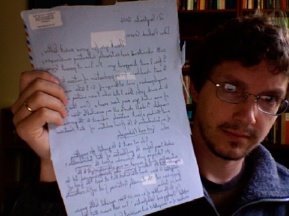 When I wrote my review of Antony Flew’s “There is a God” I was already aware of the accusations made by those like Richard Carrier that Flew was far off the deep end. Clearly, the accusation isn’t new to Carrier. It was made by others, too. I chose not to link to his extended blog entry at that time. Trust me. I really wanted to respond. To the right is a picture of Richard Carrier triumphantly holding his correspondence from Flew. The whole entry was just begging for a response. I chose not to clutter my review but now I think it’s time that I share what I can add to this debate. Here is that review.
My part of the story begins when I was in France attending the International Academy for Apologetics, Evangelism, and Human Rights. This event is hosted by John Warwick Montgomery and that year Gary Habermas was attending. Unlike Carrier, who alleges in his blog entry never to have heard of the single most formative atheist voice of the last century, I was well aware of Flew’s arguments as an atheist and also the apparent trend towards being something else. I had later heard that God and Philosophy was going to contain some definitive statement about Flew’s change of mind but it really didn’t. Knowing that Habermas and Flew were tight and being face to face with Habermas himself I just had to ask.
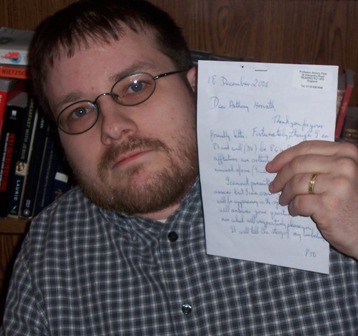 Habermas had quite a bit to say. At the conclusion of our conversations I decided that I had to write to Flew to encourage him to finally set the record straight. Habermas assured me that Flew is a gentleman who will respond to literally anyone. As you can see from the picture, Habermas was quite right. I too received a reply from Dr. Flew. I should note that between the two pictures one of us has more facial hair and we know what that means.
Now, I don’t have any desire to try to dispute the view that Flew has become forgetful in his old age. I don’t feel like I’m in a position to speak to that. What I believe I am in a position to speak to is whether or not the book, which Carrier classifies as ‘bogus’ accurately represents Flew’s position at this time. That is the key point, is it not? Even if there is a ghost writer, what we are concerned about is whether or not the writer accurately reflected Flew’s views. Continue reading



 Consider the problem that the empty tomb presents in the context of this example. If historically we are quite certain that Jesus was dead, was placed in the tomb, and that several days later the tomb was assuredly empty, we begin searching for explanations other than a resurrection. Matthew itself presents the explanation that the guards fell asleep and the disciples snuck in and stole Jesus’ body. (Note that this explanation assumes the tomb is empty and that Jesus’ body is missing).
Recent Comments